|
|
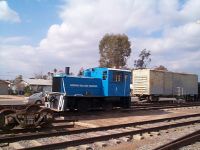
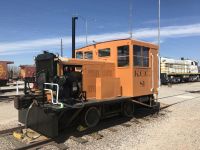
Baldwin DRS 6-6-1500 donated by Magma Metals Company.
Originally built for the McCloud River Railroad as #29. The locomotive was
built at a reduced weight from standard to permit operation on light weight
rail. Purchased in late 1969, the locomotive arrived in Arizona on January 6,
1970. The engine ran in regular service from Superior, AZ to Magma Junction,
AZ until 1991. The engine was donated to the Arizona Railway Museum in July
1994. Unlike many Baldwin diesel-electrics that have been refitted with EMD
prime movers, this locomotive still employs its original Baldwin 608SC
8-cylinder in-line diesel engine. Some mechanical restoration work has been
completed, to the extent that the locomotive is now functional. It is started
periodically to maintain its operational status, and is used occasionally for
switching cars on the museum grounds. Much mechanical and cosmetic restoration
work remains.
Historical Photos
 |
Magma Arizona #10, at Desert Wells Tank, 1/15/80.
Photo by: Bob Trennert |
|
|
|
| |
|
|
|
|
|
|
|
2-8-0 steam locomotive built in 1906 by the Baldwin Locomotive Company for the Southern Pacific RR. Builders
number 29064. SP Class C-9 it weighs 217,800 pounds, has 57 1/2" drivers with a tractive effort of 45,470 pounds.
The engine is oil fired with a working pressure of 210 Psi. The tender is a
class 100-C-4 with serial number 8365. The
engine was donated to the City of Chandler in August 1965 and placed on display at the Chandler Train Station. After
being moved to Armstrong Park in 1969, the locomotive began to deteriorate. Since 1984, the locomotive has been
cared for by the Members of the Arizona Railway Museum. The engine was placed on the Arizona State Historical Register
in 1994. Read about the history of #2562
HERE.
|
|
|
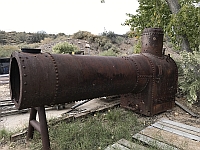
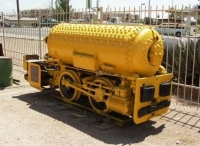
Donated
by the Homestake Mining Company. Built by the Porter Locomotive Company in
1923 as serial number 3290. The locomotive weighs 10,000 pounds on 23 inch
drivers with a tractive effort of 18,600 pounds. The boiler pressure is
1000 Psi of air with 6 X 10 inch cylinders. The locomotive was retired
in August of 1985 and donated to the ARM. This locomotive was on display
at the Mesa Museum of the Southwest from 1985 to 1997. It returned to
Chandler on June 25, 1997. |
|
|
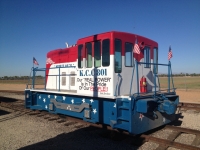
Built in a group of 24 locomotives for the U.S. War Department, serial numbers
4441 to 4464, this serial number 4463 was the last member of the group delivered
in March of 1943. It is unknown to what branch of the Armed Forces this
locomotive was allocated, or the location of its initial assignment. Donated by
Railroad Builders Inc.. in 1988. Model
ML-8 weighs 62,000 pounds on 33 inch drivers. Sold to the M. Lummis Company,
then to Pacific Railroad Contractors , then to Railroad Builders of Mira Loma
California. Unlike many of its type that have been refitted with a diesel
engine, this locomotive still employs the original Leroi RX1V V8 gasoline engine
with a displacement of 2008 cu.in. Power is transmitted to the wheels via a
clutch and 4-speed mechanical transmission, with chain drive to the axles. The
locomotive has been cosmetically and functionally restored, and is being
maintained in operating condition. It is used frequently for switching cars on
the museum grounds. In 2005, in honor of the locomotive’s long-term caretaker,
it was named the George E. Holt. |
|
|
Manufactured by the Marmon Transmotive company (now part of
Marmon Group), this Model 9000 "Switchmaster" saw service for the Arizona
Republic newspaper printing facility in Mesa, Arizona. Powered by a
Detroit 4-clinder diesel engine, this car mover was used to move boxcars loaded
with bulk printing paper. Equipped with rail wheels AND street wheels,
this unit can travel over the streets as well as move railroad cars.
Arizona Republic donated this unit to the ARM on May 7, 2006. Unit is
operational. |
|
|
This
25-ton crane was built for the U. S. Army in 1943. The unit was
stationed at the Navajo Army Depot near Bellemont, Arizona (west of
Flagstaff). The unit was sold to Valley Steel and Supply Company, Tempe,
Arizona where it served until 1995. Valley Steel and Supply donated the
crane to the Museum and it was delivered by the Union Pacific Railroad on June
28, 1997. |
|
|
Built July 1950 for Chicago & Northwestern number 5022 B (units came in
pairs). Ran on the "400" trains. In mid 1960's the steam boiler
was removed and replaced with a Head End Power generator for use in commuter
service in Chicago. At this time the number was changed to 519.
When METRA took over Chicago suburban service the engine became METRA 519.
Retired in 1991. Sold 1992 to Pacific Rail Dismantlers who numbered her
to PRDX 519. Sold 1997 to Monad Railway Equipment and numbered MREX 97.
2006 to Sonia Orlenko who moved the engine to the Arizona Railway Museum for
display and storage. Historical Photos
 |
C&NW 519,
at Oelwein, Iowa, 5/80, Jim Shepherd photo. |
|
|
|
| |
|
|
|
|
|
|
|
Verde Tunnel & Smelter "Motor Car" built by the Fairmont company. This car
is a Fairmont model S2-D Section Car, serial no. 144193. It was originally
equipped with a QBA Engine No. 50343. The shipping date of the car to the
Verde Tunnel & Smelter Railroad, Co. was September 8, 1937. The present
QBA Engine No. 61280 was provided by Fairmont on December 7, 1942 and replaced
the original for reasons unknown. The car, as originally delivered, had a
M11563 Countershaft Drive (sprocket reduction drive), still present and a M11366
"Storm King" Wide Wind Shield (no longer present). |
| Santa Fe |
| Business Car |
| #405 |
| |
| |
|
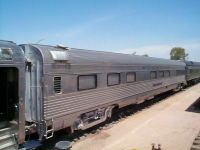
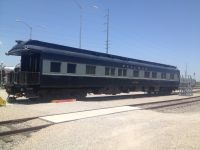
Built by Pullman, and delivered to the AT&SF in January 1927, this 52' all steel
Business Car was built as one (of eighteen) Superintendent's Cars. These
cars were used across the AT&SF system and were removed from service in 1966.
The #405 ended its service in La Junta, Colorado and was sold to San Angelo Tank
Car in San Angelo, Texas in 1968. Last stored at the Heritage Museum of
Temple, Texas. It was donated to the ARM in 2008 and
arrived in Chandler on May 16, 2008.
 |
 |
 |
|
|
| #405 on display in Temple, Texas. |
#405 in Tempe on 5/15/2008 |
#405 delivered to ARM on 5/16/2008 |
|
|
|
|
|
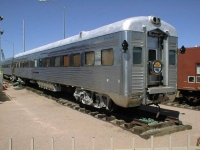
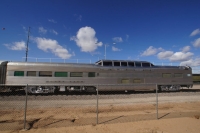
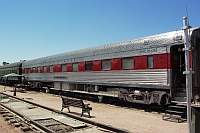
One of 6 "Pleasure Domes" built by Pullman-Standard Car Company in 1950 for the
AT&SF. Unique to the Santa Fe, the upper dome featured swivel chairs while
below was a lounge, cocktail room and the "Turquoise Room" for private dining.
The car saw Amtrak service as car #9354. It was eventually sold to Dr.
Cushman who operated the car as part of the Broadway Dinner Train in Nashville,
Tennessee. After service on the dinner train, the car was stored at the Tennessee Central Railway Museum.
This car was donated to the Arizona Railway Museum in March 2008.
 |
 |
 |
 |
| #504 arrival at the ARM March 2008. |
Interior of dome. |
Cocktail room. |
View of bar. |
| |
|
|
|
 |
|
|
|
| View of lounge. |
|
|
|
|
|
|
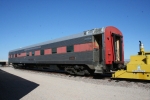
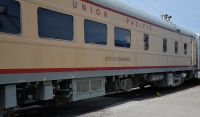
Built by A.C.F. in lot number 3032; floor plan 7667157. Delivered to the
Union Pacific in April 1949. The car was sold to Alaska Railroad in 1971,
then in 2001, sold to Monad Railway Equipment. Arizona Railway Museum purchased
the car in May 2003 and was delivered to ARM in September 2005.
|
|
Santa Fe |
|
Coach |
|
"Diablo Canyon" |
|
Photo 1 |
|
|
|
NOT ON PROPERTY |
|
Delivered by the Budd Company as AT&SF 52-seat coach 3079 the
car was one of 30 (3072-3101) ordered by the Santa Fe Railway in February of
1937. Built in lot 977 the cars were delivered from July through October of the
same year. All were placed in service on the Scout. Coach 3079 was among the 29
cars sold to NJDOT in 1969 and it was reconfigured to seat 84 commuters.
NJ Transit donated the coach to the United Railways
Historical Societies of New Jersey. Mr. John McMath bought the car in 1991. Mr.
McMath configured the car for personal use and renamed it Coco Grove. He
stripped out the coach interior and installed 4 bedrooms, kitchen, small dining
area and a solarium lounge at the vestibule end. In 1996 the car met the
requirements for Amtrak service and has continued to be mechanically certified.
The car is the oldest Amtrak certified and operable Budd built car in the
country.
Mr. McMath donated the car to the Arizona Railway Museum
April 28, 2005 at 10:20 AM on track 18 at Washington DC Union Station. Bart &
Jane Barton accepted the keys and accompanied the car as far as Tucson. The car
was delivered to the museum by the Union Pacific on Monday May 9, 2005. |
|
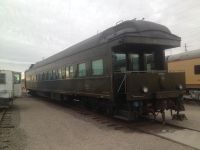
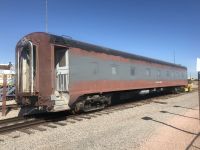
This car was originally built as an Office Car for the Southern Railway in the late 1800's. The car has been
traced to 1901 when it served as the President's Car on the South Carolina & Georgia Railroad. In 1901 the S.C.&G.
became part of the Southern Railway System and it's number was changed from 101 to 9. The latest UNVERIFIED data
shows that the car was built in the Pullman Shops in Worchester, MA in 1879. The car was number 16 on the Southern
when it was sold to the Phoenix Cotton Pickery. It was purchased from them in 1982 by Mr. Russell
Joslin who named the car the "Desert Valley". Mr. Joslin
passed away in 1993 and the family donated the car to the Arizona Railway Museum in 1995. |
|
|
44 Seat Santa Fe Coach. Built by Pullman as one of 51 cars in lot #6734 to plan #7503.
The order was entered in August 1944 and delivered in April 1947. The car entered service on the first
all coach streamliner on the Santa Fe, THE EL CAPITAN, running between Chicago and Los Angeles, via Winslow,
Flagstaff and Kingman. The car became part of the Amtrak fleet in 1971 receiving the number 4484. The car
was retired in 1976 and sold to the Pullman Pizzeria in Las Cruces, New Mexico. Sold again to Jim Bennett
of Las Cruces in 1981. This car was donated to the Museum by Mr. Bennett in 1990. |
|
|
Built by the Budd Company as one of sixteen cars in
lot number 9613 - 001. Ordered in May 1941 and delivered in March 1946 as 52
seat coach number 3166. This car saw service on many Santa Fe streamline
trains, one of which was the Hassayampa Flyer which ran from Phoenix to
Williams Junction. The car went to Amtrak in 1971 and was renumbered 5236. The
car was scheduled for shop work and conversion to 60 seats in 1976 but the
work was never done. Retired in1977 and sold to the U.S. Air Force the car was
moved to Vandenberg Air Force Base in California. The interior was mostly
removed to facilitate rebuilding as a hospitality car. The work was never
completed. The car was purchased by John Clark in 1990. Mr. Clark sold the car
in 1993 to Rail Preservation Inc. of Scottsdale, Arizona. The car
was passed on to the museum in 1996. The Arizona Railway Museum re-named
the car "Regal Phoenix" and is continuing the re-build of the car as
a full lounge. |
|
|
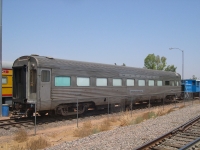
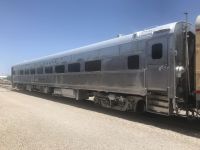
Built in 1947 by the Pullman Company for the Santa Fe
Railroad. The car had one double bedroom; four drawing rooms and a round end
observation lounge. The car was one of four built for the “Super Chief”,
the extra fare streamline train serving Chicago, Los Angeles and points
between. In 1956 the round end was modified to allow use of the car in mid
train service. In 1994 a small buffet kitchen was added when the car went to
private owners. The car was donated to the ARM by Fred & Dale Springer on
March 31, 2001. |
|
|
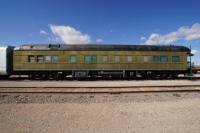
Donated by Valley Steel and Supply of Tempe,
Arizona. Built as a coach car in 1910 by Pullman. Built as a wood car on a
steel frame. The car was rebuilt around 1917 as a men’s smoking car. It was
rebuilt again in 1938 as a crew kitchen / diner for use on the wreck
train out of Barstow, California. This car is one of the last examples of wood
car construction techniques. It retains the original composite wood and steel
truck frames. Friction bearing M.O.W. number 198993 delivered by the
Union Pacific to the museum June 28,1997. |
| Santa
Fe |
| Observation |
| "Denehotso" |
Photo 1 |
|
Round end observation car, 1 double bedroom - 4
drawing room - 17 seat lounge. Built by the Pullman Company as one of six cars
in lot number 6532 to plan 4070 for service on the Chief between
Chicago and Los Angeles (via northern Arizona). The order was entered in
February 1937 and delivery was February 1938. The car was sold by Pullman to
the Santa Fe in 1948 when the Pullman Company was forced to give up it's
monopoly on sleeping cars. The Santa Fe rebuilt the car in 1954 changing the
round end to a blunt end and adding one seat to the lounge. While on the Santa
Fe the car also carried the number 1853. This was for inventory purposes only.
The car was retired in 1968 and donated to the Steamtown Foundation in Bellows
Falls, Vermont. Steamtown later moved to Scranton, Pennsylvania and some
pieces of equipment were sold at auction. This car was sold to Bill Fuehring
who sold the car to museum member Mike Salwitz. The museum purchased the car
from Mr. Salwitz in 1995. This car is the only remaining observation car from
the original train set. The other cars were rebuilt to coaches in the mid 50's
and later scrapped. The Denehotso was placed on the Arizona State
Historical Register in 1995. |
| Southern
Pacific |
| Horse Car |
| #7241 |
| Photo 1 |
|
Three
door horse car with full opening end doors,
built by St. Louis Car Company in 1937. The
livery at time of delivery was a dark olive green with gold lettering.
This was the last order of heavyweight cars placed by the Southern Pacific. In
1951 the car was converted to a postal storage car for use on the Golden
State. At that time the number was changed to 4300 and the paint scheme
changed to the
red over silver of the Golden State. In 1953 the car was
repainted to an all aluminum color with a red letter board and the Golden
State insignia on the side. In 1958 the car was again repainted, this time
to the silver with orange letterboard of the Sunset route. The early
1960’s saw the color changed to the solid grey used on all of the head end
passenger equipment. In 1966 the car was retired from revenue service and
converted to a heavy tool car at the Sacramento shops, coming out with the
number SPMW 5984. At this time the roller bearing wheel sets were removed for
use on the heavyweight business cars. In the early 1970’s the car moved to
Phoenix for use by the car repair forces. It was stationed for a time at the
Tempe depot before moving to the Phoenix yard. The car was sold for dismantle
in September 1994 to Smith and Charles Salvage. Jim Smith donated the car to
the Arizona Railway Museum in 1995. The car was moved by the Southern Pacific
to the museum on Aug. 23,1996.
Historical Photos
 |
SPMW 5984, at Tempe Station, 1/17/81. Photo by: Bob
Trennert |
|
|
|
| |
|
|
|
|
|
| Private
Car |
| "Imperial Manor" |
| Photo 1 |
|
This 4 Dbl Bedroom, 4 Compartment, 2 Drawing Room car was built by Pullman as 1 of 9 cars. The order was
placed in December 1938 and all 9 cars were delivered by July 1939. The car was originally named
"Imperial Estate"
and saw service on the 20th Century Limited. In 1948 the car was sold to the New York Central and the name changed
to "Imperial Manor" in 1950. In 1962 the car was sold to the Illinois Central RR and renamed "Hazelhurst". In 1968
the car was sold to Midwest Travel Services and again in 1980 to Rail Passenger Services of Tucson, Arizona. The car
is on semi-permanent display at the Museum. |
|
|
Built by the Budd Company as one of
six cars in lot number 9662 - 026 to Pullman plan 9503. The order was entered
in March of 1946 and delivered in August of 1949. This car entered service on
the Silver Meteor between New York
City and Miami. The car was named "West Palm Beach" and also number
42 on the Seaboard. when the
Seaboard Air Line and the Atlantic Coast Line merged the car was renumbered to 6627.
The car went to Amtrak in 1971 and became number 2704 still retaining the
name. Retired in 1986 and held at Beach Grove, the car was
purchased from Amtrak in 1992. |
| Private Car
|
| "Promontory Point" |
| Photo 1 |
| |
| NOT ON PROPERTY |
|
Built as the 6rmt 4dbr 6sec sleeper “Loblolly
Pine” for the Chicago and Eastern Illinois railroad in 1953. Became staff
sleeper number 652 in 1968. Sold to Louisville and Nashville railroad in June
of 1969 remaining number 652. Sold in 1974 to Autoliner Corporation who
rebuilt it to business car number 101. Sold to Missouri Pacific railroad in
1976 as M.P. number 2. Jimmy Carter in his 1976 whistle stop campaign
train used this car. Acquired by Union Pacific in 1985 with buyout of M.P.
Union Pacific numbered the car 105. It served as Salt Lake Superintendents car
until 1994. At times this car also carried the names "Little Rock"
and "Houston" and was also number 109 for a short time. Was out of
service until 1997 when it was purchased by Railcar Preservation. Car is
undergoing mechanical upgrade to Amtrak standards and car interior is being
restored and upgraded. Arrived at ARM November 1997. |
 |
| Anode Flat Car |
| AZER #7013 |
 |
| |
| |
|
70-ton wood
deck flat car 53’6” long with a deck area of 535 sq ft. The car is unique in
that the frame largely consists of a one piece steel casting. It was built in
June 1966 by General Steel Corp at Granite City, Illinois, possibly for the Rock
Island. It is called a “Commonwealth” type car (the plant was formerly owned by
Commonwealth Steel) and was rather ubiquitous during that period. It was used in
general freight service. The SP subsequently obtained it and became part of the
SP 7000xx-series. Forty-five cars apparently made up this series (unknown which
SP car is the AZER 7013). The SP class designation for this car was F-70-92G. In
April of 1986, it was apparently reconfigured into an anode flat car by
Gunderson Industries.
|
|
|
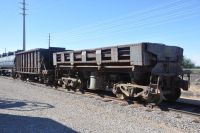
This outside dump – Ingoldsby
design 14 latch, side dump ore car was built for the Ray and Gila Valley
Railroad by the Pullman Company in 1910. The 15 foot dump doors can be operated
manually or with an air assist. The Ray Consolidated Copper Company has changed
name and ownership a number of times in the last 100 years but the car has
remained in Arizona. Donated by the Copper Basin Railroad in 2007. |
|
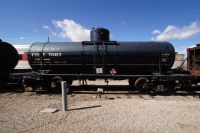
Built by Union Tank Car Company in November of
1936 as car UTLX #7682.. Car is of riveted type construction with a light weight of 42,800
pounds. It has a capacity of 6545 gallons or a fully loaded maximum weight of
80,000 pounds. This type of car was built to carry non pressure type liquids,
ICC class 103. In the early 1970’s the car was sold to PROTEX INDUSTRIES of
Denver, Colorado. The reporting marks were changed to PDAX #1057. The car was
in service until 1995 when it was sold to Busby Metals of Mesa, AZ for scrap.
Busby Metals then donated the car to the museum. |
|
|
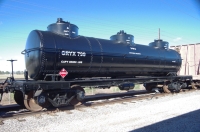
G.R.Y.X. #799 is a three dome - three compartment tank car. The car was purchased by the Museum from Valley
Steel and Supply. The outside rivet construction car has three separate compartments used to carry chemicals and
solvents. It was originally built for the W.R. Grace Company in 1938. |
|
|
This single dome tank car was built in 1942 for the Southern Pacific and has a riveted tank body.
Donated by M.P.C. Distributing of Phoenix it was used to carry fuel oil. The car has been restored by an
Eagle Scout as an Eagle Scout Community Service project. |
|
|
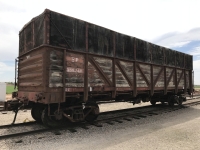
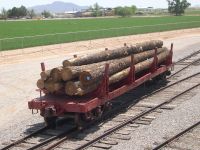
This pulpwood flatcar was used in forestry service on the Santa Fe in northern Arizona to haul pulpwood logs to
the mill. It was originally built as a GA-80 mill gondola at Cleburne, Texas in 1967. It was rebuilt under job # F-1257.
Job # F-1594 saw the application of 3/16" steel plate to the bulkheads. |
|
|
This flat car was donated in October 2005 to the Arizona
Railway Museum. The car saw extensive service on the Tucson, Cornelia &
Gila Bend. The car currently sits on Arch-Bar style trucks built by the
Monitor Company. Ongoing investigation for history/build data. |
|
|
Car was built by Bettendorf between 1917 and 1920 for one of
the Southwest Forest Industry predecessors. Car was used to carry logs from
the forest to the saw mill. This car saw service to the mill in Flagstaff and
was also used on the White Mountain line to the mill at McNary. For a number
of years the car was on display at the saw mill in Flagstaff with SWF steam
engine number 25. Car was donated to the Arizona Railway Museum by the City of
Flagstaff in 1999. |
|
|
This 40' refrigerator car was built by American Car & Foundry in 1920 for the Santa Fe to carry
perishable items to
the eastern markets. This car was one of 1250 built in the "W" class. This was the first class of refrigerator car built on a steel
frame. The car was built as a wood car with wooden racks and ice bunkers. Cars in class RR-W were rebuilt by the Santa Fe in 1937
with steel sides and steel floor grates. After the rebuild the cars were renumbered into a series beginning at 16000 and given the
class designation RR-23. The car was donated to the Museum by Cactus Distributing of Phoenix. The car is intact and retains the
1937 style ice racks inside. |
| 60' Refrigerator Car |
| SPFE #459579 |
| Photo 1 |
|
This 60' mechanical refrigerator car was built in April of
1971. The car was used to carry perishables to markets outside Arizona.
Oranges, grapefruit, lettuce, potatoes and melons were loaded at docks in
Mesa, Higley, Tempe and Phoenix for shipment to markets outside Arizona. The
car is a model R-70-24. It had an on board diesel powered refrigeration
system, which could maintain the temperature inside the car just above
freezing level. The car was retired in 1995 and donated to the museum in May
of 1996 by the Southern Pacific Railroad.
|
|
|
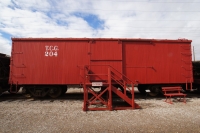
Originally built in 1909 by American Car & Foundry for the
Denver & Rio Grande Western as a 40’ wood side sugar beet car. This car
eventually was rebuilt by the D&RGW in 1926 and sold to TC&GB and placed in
service as #204 on the Gila Bend-Ajo line where it served until 1996 when it was
sold to a former mine employee. Since 1996, this car has sat in silent repose
at the Phelps Dodge mine in Ajo, Arizona. |
|
|
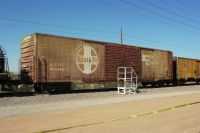
This 40' boxcar was built as a double door car for the Santa Fe. The original number of the car was 5257. The car eventually
was de-rated to a MOW Bolt Car which carried miscellaneous bolts and tools for the Maintenance Crews. It was donated the Museum by the
Santa Fe RR. The Museum plans to strip the MOW silver paint and repaint the car a dark green and add the Arizona Railway Museum's logo.
|
|
|
60 Foot double door donated by the Santa Fe Railroad. This
boxcar was one of 33 of this type built in the Topeka shops of the Santa Fe in
1964. A.A.R. mechanical designation XM, Santa Fe Class BX-88. Cars
were modified in 1973 on job number B-2043. Original numbers were from
37400 - 37410 & 37412 - 37439. |
|
|
This woodside caboose served the Phelps Dodge copper mine in
Ajo, Arizona. It was built in the company shops in 1944 to AAR freight car
height specifications. It was used for numerous years to provide passenger service
between Gila Bend and Ajo. One way fare was $0.97, round trip $1.94,
half price for children 6-12. Interior configuration is unusual in that it is
equipped with dual toilets (men and women). Side doors allow for freight
loading on one end. Roof mounted tank provided water storage.
Caboose was donated to ARM by Phelps Dodge and delivery was completed on August
15, 2006. Historical Photo 1 was taken at Gila Bend on November 26, 1976 by
Bob Trennert. |
|
|
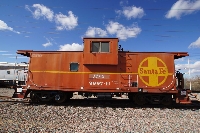
This caboose was built by International Car Company of Kenton, Ohio in April 1978 for the Toledo,
Peoria & Western RR. In 1986 it was absorbed into the Santa Fe system and retired in 1992. The caboose saw
service in the Phoenix area and was donated to the Museum by the Santa Fe RR directly from the Phoenix yard.
This is an example of a center cupola, wide vision, model Ce-8 caboose.
Historical Photos
 |
ATSF 999741, at Phoenix, 4/27/91. Photo by: Bob
Trennert |
|
|
|
| |
|
|
|
|
|
|
|
Built in 1947 in the Los Angles Shops of the Southern Pacific RR for the subsidiary Texas & New Orleans RR
#512. It was retired from the Southern Pacific RR in 1982 and donated to the Arizona Chapter of the NRHS.
The Arizona Chapter of the NRHS donated the car to the ARM in 1994 and has been EXTENSIVELY remodeled
inside to serve as a "Crew Car' for Museum Workers. It now features a refrigerator, shower, microwave, TV,
chemical toilet, lockers and air conditioning. This is an example of a model C-30-4 caboose. |
|
|
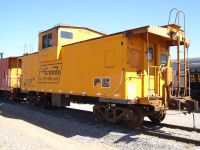
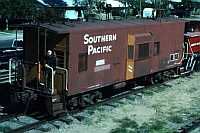
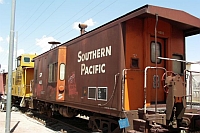
The
International Car Company of Kenton, Ohio built this Model C-50-9, Southern
Pacific Caboose, in April 1978. The caboose was used in
mainline service out of Tucson, Arizona until 1994. The Caboose was last used in service on the Buckeye Local out
of Phoenix, Arizona and donated to the Museum in 1996. |
|
|
| 120 Ton Steam Derrick |
| SP #7130 |
| Photo 1 |
|
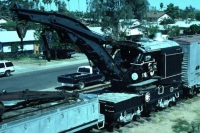
SPMW 7130 is an oil-burning, steam-driven,
non-self-propelled railroad wreck crane which was built in 1910 as Construction
Number 2250 by Bay City Industrial Works at Bay City, Michigan, for the Southern
Pacific Railroad (SP). The crane, then-numbered SP 620, was placed in SP service
at Tucson, Arizona, in 1910. In 1934, it was renumbered as SPMW 7034, then again
as SPMW 7028 in 1940, and yet again in 1969 as SPMW 7130. It remained in service
based at Tucson until decommissioned in 1989. It is primary use was in
connection with railroad accidents and derailments involving both freight and
passenger trains on SP lines at or near Tucson, Arizona.
SP #7130 was placed on National Register of Historic Places on December 29,
2007. |
|
|
| 120 Ton Steam Derrick Tool Car |
| SP #7131 |
| Photo 1 |
|
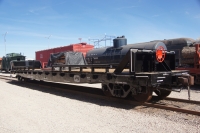
SPMW 7131 is an auxiliary tool car which has custom-made
compartments to carry tools, equipment and supplies necessary to assist
operation of the crane in wreck service. This car was originally a wood deck
flat car, one of several such cars constructed for the SP in 1949 by American
Car and Foundry Company. It was converted into a tool car sometime prior to 1969
(records reflecting this conversion are fragmentary) and assigned reporting mark
SPMW 7028A. In 1969, it was given its current designation of SPMW 7131.
SP #7131 was placed on National Register of Historic Places on December 29,
2007. |
| Private Caboose |
| DRGW #01469 |
| Photo 1 |
|
This caboose was built in 1951 for the Denver & Rio Grande RR and rebuilt in the Burnam Shops in 1972.
It last saw service on the Monarch Branch in Colorado. It was retired in 1992 and purchased as a private car
by a Museum Member. This is an example of an offset cupola caboose.
Historical Photos
 |
D&RGW 01469, at Salida, CO, 9/12/71, R. R. Harmen photo. |
|
|
|
| |
|
|
|
|
|
|
|
This car was built in 1980 by the International Car Company for the Southern Pacific RR. It was used in local service based out of
Eugene, OR. It was purchased as a private car by a Museum Member and is a fine example of a modern, bay window,
model C-50-9 caboose.
 |
|
 |
|
|
| 6/6/2009 - Caboose gets new paint. |
|
6/6/2009 - Caboose gets new paint. |
|
|
|